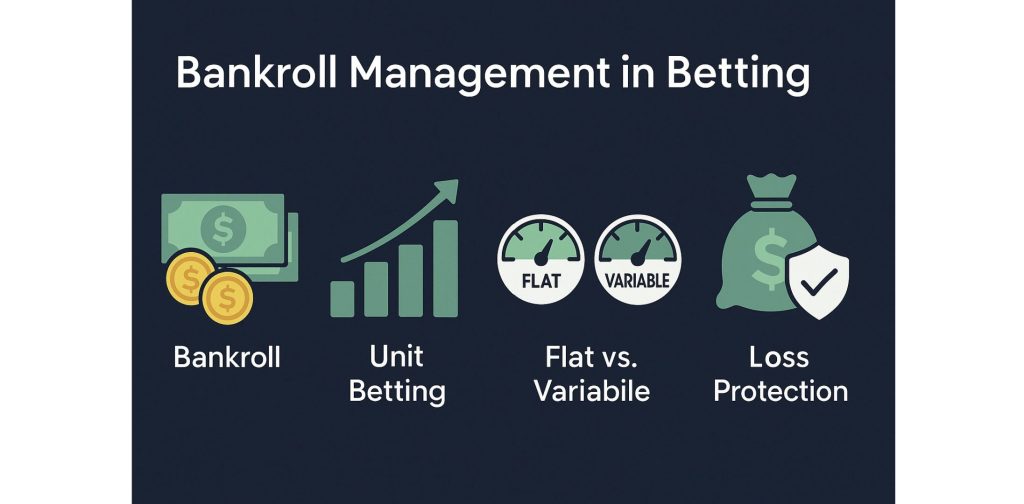
Bankroll Management in Betting: How to Stay in the Game (2025 Guide)
Bankroll management is the difference between “I had a bad day” and “I can’t play anymore.” Even with solid picks, variance happens—form changes, odds move, and results swing. A clear staking plan helps you avoid emotional decisions, survive losing streaks, and keep your betting sustainable over time.
Quick Summary
- Use a staking range: many players aim for 1% to 5% of bankroll per wager, adjusting based on risk and experience.
- Choose a staking method: flat betting is simpler; variable stakes can optimize results but increases risk.
- Protect your bankroll: set a budget you can afford to lose, track bets, and avoid chasing losses.
- Stay consistent: use units, reduce stakes during drawdowns, and take breaks to prevent “tilt.”
- Always check the latest details: if you use systems like Kelly, confirm the math and assumptions with your own betting conditions.
Table of Contents
- Why Bankroll Management Matters
- How Much Should You Bet Per Wager?
- Flat Betting vs Variable Stakes
- Key Factors to Build a Bankroll Plan
- Key Factors Comparison Table
- 5 Essential Bankroll Management Tips
- Decision Checklist Before You Place a Bet
- Common Mistakes to Avoid
- Related Internal Resources
- FAQ
Why Bankroll Management Matters
Most bettors don’t lose because their picks are “always wrong.” They lose because their money plan breaks. Bankroll management helps you deal with:
- Emotional betting: after a loss, you may want to “win it back.”
- Losing streaks: variance can be brutal even for disciplined bettors.
- Confidence drift: people increase stakes after small wins or after a strategy feels “on fire.”
- Cash-out problems: if you don’t budget for drawdowns, you’ll stop too early or bet your limit.
If you want betting to be a long-term side hustle (not a weekend gamble), bankroll control is the foundation. It doesn’t guarantee profit—but it improves your ability to keep playing while outcomes normalize.
How Much Should You Bet Per Wager?
A widely used guideline is to stake 1% to 5% of your total bankroll per wager. This range is popular because it aims to:
- keep you in the game during cold streaks,
- reduce the risk of rapid bankroll depletion, and
- allow consistent decision-making instead of “all-in recovery” attempts.
How to choose your exact percentage:
- Start lower (closer to 1%–2%) if you’re new, if your edge is unproven, or if you place bets frequently.
- Move higher (closer to 3%–5%) only if your process is consistent and you understand the risk you’re taking.
- Adjust downward during drawdowns rather than doubling down emotionally.
Practical tip: treat your staking plan like a system. If your bankroll drops meaningfully, consider reducing your stake size until you stabilize.
Want to pair your staking plan with better selection? Explore our guides on betting tips and use odds checking before you commit.
Flat Betting vs Variable Stakes
How you structure your stake matters as much as how big it is. Two common approaches are flat betting and variable staking.
Flat Betting
Flat betting means betting the same amount every time (for example, a fixed amount like $20 per bet).
- Pros: simple, easy to follow, helps reduce emotional variation.
- Cons: may limit upside because the stake doesn’t adapt to risk and confidence.
Variable Stakes
Variable staking changes your stake depending on confidence, odds, or a mathematical method (for example, approaches inspired by the Kelly Criterion).
- Pros: can optimize profit expectations when your assumptions are accurate.
- Cons: can become risky if confidence is misjudged, if you apply it without understanding inputs, or if you allow emotion to drive “confidence.”
Important note
Any formula-based staking method depends heavily on assumptions. If you’re unsure about the inputs (probabilities, true edge, or market efficiency), consider starting with a simpler framework like flat staking with a fixed percentage of bankroll and then iterating after you have enough data.
Key Factors to Build a Bankroll Plan
Before you choose a staking percentage, decide what you’re optimizing for. Different bettors have different goals: survival, steady returns, or a more aggressive profile.
1) Define “bankroll” clearly
Your bankroll should be the total amount you allocate for betting activities. Include:
- how much you set aside specifically for wagers, and
- how much you will stop betting with (your “max drawdown” tolerance, even if it’s informal).
Do not treat your entire savings or short-term money as bankroll.
2) Use units to standardize bets
Many bettors use “units” to reduce confusion. Example: 1 unit = $10. Then, instead of thinking in dollars, you think in units (like 0.5u, 1u, 2u). This can help you stay consistent even when the bankroll changes.
3) Account for variance and drawdowns
Even a good approach can go through slow periods. Decide in advance:
- What happens if you lose 5, 10, or 20 bets in a row?
- Will you reduce stake size? Take a pause? Keep the same percentage?
4) Match stake size to your decision quality
If your bets are based on a repeatable process (research, odds comparison, and clear criteria), you can be more confident. If bets are impulsive, reduce stake size or pause until you return to your process.
5) Avoid “ROI blindness”
ROI is important, but so is long-term performance. Don’t make stake changes based only on a few short wins. Track trends over enough samples to reduce randomness.
Key Factors Comparison Table
| Factor | Conservative Approach | More Aggressive Approach | Best For |
|---|---|---|---|
| Stake size per bet | Lower end of 1%–5% | Upper end of 1%–5% (or variable sizing) | Newer bettors vs experienced bettors with a stable process |
| Bankroll definition | Dedicated amount you can afford to lose | May include more sources (higher risk) | Survival vs maximizing short-term activity |
| Bet sizing model | Flat betting / fixed units | Variable stakes based on confidence/odds | Consistency vs optimization |
| Drawdown handling | Reduce stakes and/or take breaks | Maintain or increase stakes (higher risk) | Risk control vs higher volatility tolerance |
| Tracking & review | Log bets, review outcomes, refine criteria | Less tracking (common early mistake) | Long-term improvement vs “feel-based” decisions |
5 Essential Bankroll Management Tips
- Set a bankroll amount you’re OK losing: don’t bet rent money or money needed for essentials.
- Use units to standardize your bets: for example, 1 unit = $10. This makes staking decisions easier to follow.
- Track your bets: use a spreadsheet (Excel/Google Sheets) or a betting tracker app. Track stake, odds, date, and outcome.
- Separate emotional and logical bets: if you feel rushed or angry, pause. Logical bets come from your criteria—not your mood.
- Take breaks during bad streaks: don’t tilt. If you’re chasing losses, you’re no longer making decisions—you’re reacting.
Decision Checklist Before You Place a Bet
Use this quick checklist to sanity-check your next wager.
- Did I compare odds / market price? If the number moved, does the bet still make sense?
- Does this match my criteria? If not, reduce stake or skip.
- What stake am I using? Is it within your planned 1%–5% range?
- How does this bet affect my bankroll? Would a few more losses threaten my ability to continue?
- Am I betting to recover losses? If yes, stop and revisit later.
- Would I place this bet if I weren’t currently “up/down”? If you only want it for emotional reasons, don’t take it.
Common Mistakes to Avoid
- Chasing losses after a bad day: this often leads to larger stakes and worse decisions.
- Betting more because you “feel lucky”: emotion is not a betting model.
- Increasing stakes without logic: if you change stake size, explain why using your process.
- Ignoring long-term ROI: short-term swings can distort perception of skill.
- Overusing variable stakes: variable sizing can be useful, but it can also amplify mistakes if confidence is not measured well.
Related Internal Resources
- Crypto casino comparison (useful if you also diversify into casino games and want to compare payout mechanics and game transparency)
- Crypto exchange comparison (helpful when you manage bankroll across deposit/withdrawal workflows)
- Bankroll management guide hub (for more risk-control concepts and practical planning)
FAQ
1) What is a safe bet size for bankroll management?
A common guideline is to bet 1% to 5% of your total bankroll per wager. Many beginners start closer to 1%–2% to reduce drawdown risk. You should choose a stake size that matches your experience and how much variance you can tolerate.
2) Should I use flat betting or variable stakes?
Flat betting is usually better for consistency and emotional control. Variable staking can be effective when you have a repeatable edge and understand how your confidence assumptions translate into stake size. If you’re unsure, start with flat staking using units or a fixed bankroll percentage.
3) How do I handle a losing streak?
Stick to your plan. If your plan allows it, reduce stake size and/or take a short break. Avoid chasing losses. Also review whether your decisions are still aligned with your criteria (selection, odds, and timing).
4) Do I need to track every bet?
Tracking is strongly recommended. Logging your stake, odds, date, and results helps you see patterns and assess whether your approach is improving. Without tracking, it’s easy to confuse luck with skill.
5) Can bankroll management guarantee profits?
No. Bankroll management helps you manage risk and stay in the game, but betting outcomes still involve variance. If you want updated information for odds, markets, or any staking model assumptions, check the official websites and your sportsbook’s rules for the latest details.
Risk / Responsible Use Disclosure
Betting involves risk and may not be suitable for everyone. This article is for educational purposes and does not guarantee results or profitability. Never bet money you cannot afford to lose, and avoid chasing losses. If you feel betting is becoming harmful or hard to control, consider seeking professional help or using responsible gambling tools provided by your sportsbook or local support organizations. Always check the official terms, odds movements, and staking rules of your provider before placing bets.